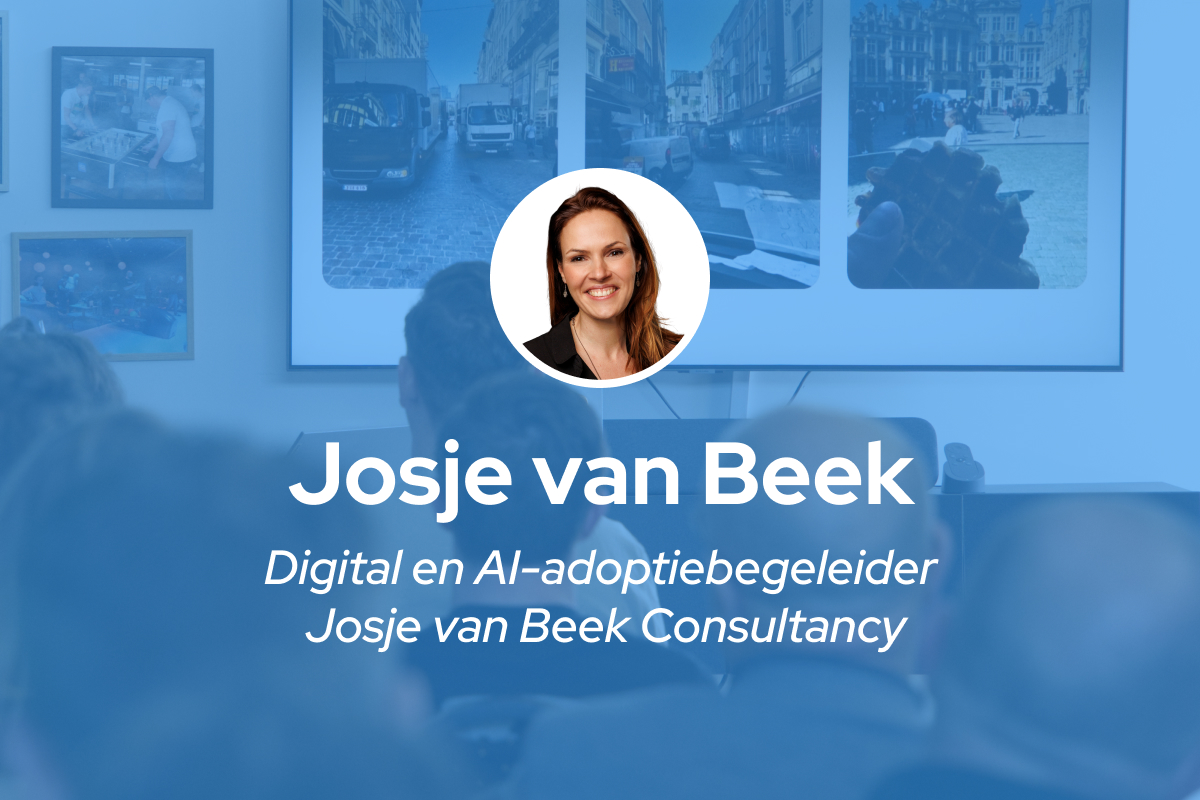
Ahead of the Logistics & Delivery Lunch Event, we spoke with Josje van Beek, a digital and AI adoption consultant and author of the book *Working with Your Digital Colleague*. She helps organizations not only implement AI but make it truly functional, not by focusing on the technology, but on the people, processes, and collaboration.
During the Logistics & Delivery Lunch Event on October 1st, Josje will walk the audience through what is really going on when AI projects stall and what it takes to move from experimentation to real value.
AI is changing the rules of the game
Josje has been guiding organizations through change and digitalization for over 15 years. Yet, she sees this moment as fundamentally different from previous technological shifts.
"What makes this different from everything that came before is that AI now executes, acts, and makes decisions independently. But not only that, it does so with bias. Humans have cognitive biases, and so does AI. That is truly new."
While previous technology provided insights, AI now actively takes over work. And that affects not just one function, but all functions simultaneously. That makes the impact on people and organizations of a different order than ever before.
The biggest challenge is not the technology
Globally, the vast majority of organizations are already using AI, but only a small fraction are actually deriving value from it. Josje recognizes that gap immediately.
According to her, AI projects don't fail because of the technology, but because of two things: role clarity and psychological maturity. Who does what now that AI is taking over work? And can people consciously choose how they relate to something that fundamentally changes their jobs?
"If you tell someone they have to use a tool, some will and others won't. Then we start pushing and punishing people for not using it. But if you understand why someone isn't using it, you can actually solve it quite simply."
Change requires more than technology
The most common mistake is what Josje calls 'training first': sending everyone to a co-pilot training session and thinking that's the end of it. Another variation is redesigning all processes with the expectation that people will naturally follow. Neither works.
"A mix of different elements is needed, in which human skills play a major role. Ultimately, it's about change that impacts people. That is the core."
What organizations underestimate is that, alongside their technical skills, people possess contextual knowledge built up over years. That knowledge is not in the system taking over their work. You want to preserve that value, but doing so requires a completely different way of looking at work and roles.
The role of the human is changing, but not disappearing
As planning becomes increasingly smarter and takes over work, the role of the people working with it changes drastically. Josje observes that tasks you previously did on the side now become more explicit and require more attention.
"Think about providing context to AI. You might have done that on the side while building something before. Now, you essentially create a briefing for it. And then there is curation: overseeing the quality of what AI produces. And furthermore, the ability to see the impact of what you are building on other parts of the organization."
According to Josje, this requires a different view of jobs and roles. Not jobs as they are currently described, but roles that are necessary to make the whole system work, even when part of that work is done by AI.
Curiosity as a starting point
Josje hopes that after her session, visitors will go home feeling more curious and will engage in conversation with one another more often.
"I hope they see that there isn't just one truth. It is precisely by exploring together that a more complete picture emerges. Together, we possess the facts; no one has them all on their own."
Hear firsthand how AI adoption really works
During the Logistics & Delivery Lunch Event on October 1st, Josje will walk you through what actually happens when organizations start working with AI, why it so often stalls on the human side, and what you can do today to break through that.
Do you want to hear her story for yourself and discover what you can do differently starting tomorrow? Make sure to be there and reserve your spot for the Logistics & Delivery Lunch Event on October 1st.





.jpg)