Blog overview
/
Cities are getting crowded. How do we keep urban logistics moving?

Cities are getting crowded. How do we keep urban logistics moving?

17/2/2026
Patrick Okkersen
Reading time approx.
2
minus

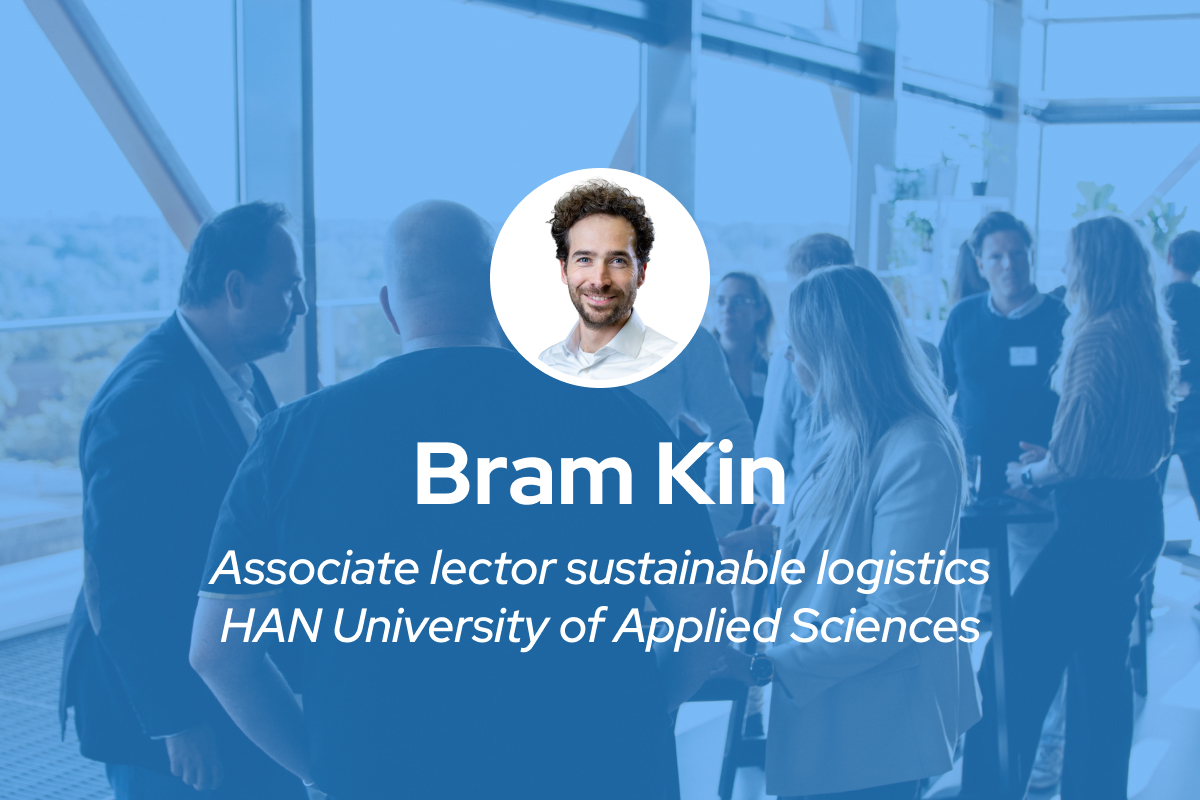
Cities are becoming more crowded and logistical pressure is increasing. Leading up to the Logistics & Delivery Lunch Event, Bram Kin, associate lecturer at HAN University, shares his insights on what this means for organizations in the city.

Urban logistics is changing rapidly. More vehicles, less space, and stricter demands from cities are creating increasing pressure on operations.

Leading up to the Logistics & Delivery Lunch Event, we spoke with Bram Kin, associate lecturer in sustainable urban logistics at HAN University of Applied Sciences. During his session, he will show what these developments mean for organizations that rely daily on urban distribution and what choices you can already make today.

Logistics is indispensable, but is under pressure

According to Bram, the problem isn't with a single system or rule, but with how we approach urban logistics as a whole. We primarily perceive transport movements as a nuisance, while they are an essential part of the city's daily functioning.

Offices require supplies, consumers place online orders, hospitality relies on frequent deliveries, waste collection keeps public spaces clean, and maintenance services ensure buildings remain functional. All these activities involve logistical movements, especially in busy urban areas.

This tension converges in the last mile. Within fixed agreements with customers and increasingly strict conditions, carriers try to organize their routes as efficiently as possible, in the part of the chain where it is most difficult.

The perception of urban logistics is too limited

What Bram often observes is that urban logistics is too quickly reduced to parcel delivery or retail supply. While in reality, parcel vans typically constitute only a small fraction of logistical traffic in cities.

The largest share consists of delivery vans in the service sector and construction. Think of installers, maintenance technicians, and other service-oriented transport movements. This broad mix defines the daily streetscape and makes urban logistics more complex than often assumed.

When policy and spatial planning are primarily tailored to a limited part of reality, friction arises. There is too little space to stop or unload, dwell times increase, and drivers have to divert to inconvenient locations. This increases the nuisance, while all measures are precisely intended to limit it.

More logistics, less space

Logistical pressure will continue to increase in the coming years. Research shows that the number of vehicle kilometers in urban logistics will grow by almost twenty percent towards 2035, while the available space for traffic decreases.

According to Bram, this calls for different choices. Logistics remains a structural part of the city. The challenge lies in smarter use of the available space. This means more dynamic space utilization, considering the spatial demands of logistics when designing neighborhoods and streets, and logistical models that enable greater consolidation.

Without behavioral change, it will grind to a halt

The customer's role is important here. In logistics, the saying often is: you ask, we deliver, preferably at the lowest possible cost. But if we want to organize urban distribution with less nuisance, customer behavior is essential.

For large institutions, purchasers play an important role, influencing how and when supplies are delivered. An individual consumer ordering online, however, needs to be encouraged towards more sustainable ordering and collection behavior. Bram also emphasizes the role of the shipper. As the client of logistics companies, they have a direct influence on how transport is organized, because demand-side choices impact planning and transport movements in the city.

What makes collaboration possible

When logistics are no longer organized exclusively per organization, other possibilities emerge. Bram points to forms of collaboration where parties consolidate loads heading to the same area or share facilities such as vehicles, storage capacity, and charging infrastructure. Such models reduce empty mileage and cut costs, especially in densely populated areas.

There is also potential on the receiving end. One example Bram mentions is the joint organization of commercial waste collection within an area, which prevents multiple parallel collection routes and reduces the number of transport movements.

Where it's already working

Sometimes the urban context forces different solutions. The supply of hospitality businesses along Utrecht's Oudegracht by boat shows how vulnerable space necessitates new logistical choices.

In other cases, clear direction helps, such as at The Hague's logistics hub where multiple buildings consolidate their supplies. Solutions like digital keys for deliveries outside opening hours also demonstrate that collaboration enables new forms of urban logistics.

Why you don't want to miss this session

During his session, Bram will show why urban logistics will only become more complex in the coming years and what that demands from organizations relying on reliable distribution. He will further elaborate on what these developments look like in practice and what role organizations themselves can play in smarter urban logistics organization.

You will gain insight into the developments directly impacting operations, the role of collaboration and space utilization, and which choices are already making a difference today.

Sign up for the Logistics & Delivery Lunch Event and hear Bram Kin's full story during his session. You'll leave with new insights, concrete examples, and a clearer picture of what's needed to organize your logistics operations for the future.

Sparring about your ideal reception experience?

Thank you, your request has been received.
Oops! Something went wrong while submitting the form.

More blogposts

March 16, 2026

Why urban distribution often fails in the last mile

Patrick Okkersen
The biggest challenge in urban distribution is often in the last few meters. Ahead of his session at the Logistics & Delivery Lunch Event, Melle Sprenger explains why deliveries get stuck there and how technology can help drivers.
Read more
arrow
March 2, 2026

Urban logistics is changing. How Bolscher future-proofed his distribution

Anick Quee - De Buijzer
Urban logistics is changing rapidly. Leading up to the Logistics & Delivery Lunch Event, speaker Roy Bolscher offers a brief preview in this blog of his keynote on how he future-proofed his distribution.
Read more
arrow
RoutiGo - Slimmer, groener en menselijker in digitale groei
December 11, 2025

Why Digital Transformation Only Works If You Keep It Human

Anick Quee - De Buijzer
Digital transformation often revolves around technology, but Patrick Okkersen shows progress happens when AI, leadership, and humanity converge. What does this mean for building software that truly transforms organizations?
Read more
arrow
November 13, 2025

Control, growth, and progress: the RoutiGo approach behind Crisp’s success

Patrick Okkersen
For years, Crisp worked with RoutiGo on a delivery operation that adapted to growth, peak periods, and new markets. What started as route planning evolved into a strategic partnership that provided control, flexibility, and scalability.
Read more
arrow
Logistics & Delivery Lunch Event | Erik Jan Elsenaar over klantbeleving
September 25, 2025

Erik Jan Elsenaar on customer experience: "The last mile is the moment of truth."

Anick Quee - De Buijzer
The last mile is the moment of truth: a single delivery can make or break the entire customer journey.
Read more
arrow
September 11, 2025

RoutiGo on the ultimate customer experience: “The next step is the driver who, with the right tools, completes the experience”

Patrick Okkersen
The next step in last-mile delivery? It's not just about tight time windows, but about empowering drivers with the right tools to complete the experience.
Read more
arrow
Logistics & Delivery Lunch Event | Plus Retail
August 22, 2025

PLUS Retail on the ultimate customer experience: “Every interaction is an opportunity to make all the difference”

Anick Quee - De Buijzer
At PLUS Retail, every interaction counts. During the Logistics & Delivery Lunch Event, Maurice Buring and Arvid Nieuwsma will explain how they combine customer-centricity and technology to achieve the ultimate customer experience.
Read more
arrow
July 21, 2025

Smarter delivery starts with control over your operation

Patrick Okkersen
The delivery world is changing rapidly. Customers expect clarity and speed while you maintain operational control. Read how RoutiGo helps delivery companies with smart, scalable software—from efficient routes to real-time tracking solutions.
Read more
arrow
July 21, 2025

Customer Story: Adzaagt

Patrick Okkersen
AdZaagt optimizes delivery with RoutiGo: smart route planning, automatic track & trace, and real-time insights for more efficient deliveries.
Read more
arrow
May 1, 2025

Key takeaways from the Logistics & Delivery Event

Anick Quee - De Buijzer
AI is no longer a futuristic concept: during the event, we discovered how you can already smartly implement it in logistics and delivery today.
Read more
arrow
March 5, 2025

AI in delivery logistics: hype or opportunity?

Anick Quee - De Buijzer
AI in delivery logistics: hype or opportunity? Melle Sprenger, CTO of RoutiGo, shares his vision on how AI truly adds value to route planning and customer communication. Read more and discover the future of AI in logistics!
Read more
arrow
February 24, 2025

Discover how AI is changing the future of logistics and delivery

Patrick Okkersen
AI in logistics: hype or opportunity? On April 10, 2025, Jasper Wognum reveals how to smartly deploy AI for efficient delivery. Read our interview on how he breaks down misconceptions and strategically uses AI for real impact in logistics.
Read more
arrow
February 24, 2025

Customer Story: DPD

Patrick Okkersen
DPD NL improves their first-mile pickups with RoutiGo: real-time updates, more efficient planning, and satisfied customers.
Read more
arrow
January 30, 2025

What are zero-emission zones and what do they mean for the logistics sector?

Anick Quee - De Buijzer
Zero-emission zones have been a reality in 14 Dutch municipalities since January 1st – what does this mean for your logistics? Discover the impact on your fleet, infrastructure, and costs, and how to respond smartly.
Read more
arrow
December 19, 2024

The future of logistics: How RoutiGo helps you stay ahead

Patrick Okkersen
Zero-emission zones, digitalization, and sustainability are transforming the logistics sector. With RoutiGo, you optimize routes, leverage AI, and make sustainability visible. Discover how we're preparing your logistics for 2025 and beyond!
Read more
arrow
November 21, 2024

Electrification, Eureka, Hospitality!

Patrick Okkersen
The hospitality sector is at a logistics turning point: electrification, digitalization, and urban challenges are forcing suppliers to become future-proof. Are you ready for the next step?
Read more
arrow
July 10, 2023

RoutiGo Nominated for Computable Awards 2023

Patrick Okkersen
In the Customer Experience category, RoutiGo is one of the ten nominees for a Computable Award.
Read more
arrow
November 6, 2023

Green Friday vs Black Friday: Business Development Director Anick explains

Anick Quee - De Buijzer
Anick: “It's clear by now that Black Friday needs to change. But many people still don't realize that it *can* be different.
Read more
arrow
August 9, 2023

The role of route optimization software in creating the ultimate delivery experience

Patrick Okkersen
How to create the ultimate delivery experience using route optimization software.
Read more
arrow
October 7, 2024

An Afternoon Full of Inspiration: A Look Back at Our Logistics & Delivery Lunch Event!

Patrick Okkersen
On Thursday, October 3, 2024, we proudly hosted our second Logistics & Delivery Lunch Event, an afternoon entirely dedicated to the theme of safe and sustainable driving.
Read more
arrow